
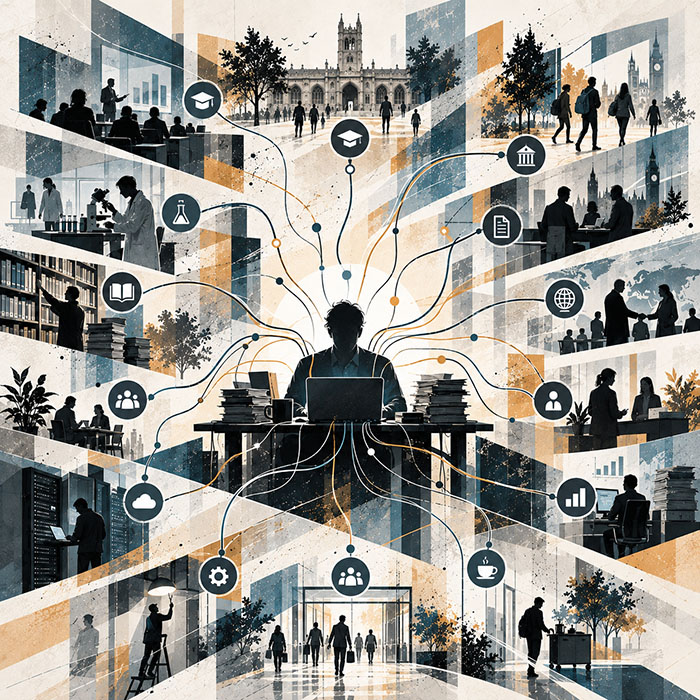
Meet Dave.
Every institution seems to have one.
Dave knows everything.
He knows why that process works the way it does. Which spreadsheet is actually the important one. What that mysterious field in the CRM means. Who approved the workaround in 2019. And which router to restart when the internet dies.
People leave. Dave gets the handover.
Teams change. Dave remembers why.
Systems get replaced. Dave knows what the old one used to do.
Processes evolve. Dave knows which bits you’re supposed to ignore.
Nobody actually asked Dave to know all this.
It just sort of happened.
Dave Is Basically Infrastructure Now.
Just infrastructure with a pension.
128GB of memory. Near-instant retrieval. Remarkably good uptime.
Unfortunately, there’s only one instance.
Dave is fully integrated with every department. Nobody remembers how.
Dave has no documentation. Dave is the documentation.
Dave is backwards compatible with systems you switched off six years ago.
Dave has survived restructures, migrations, reorganisations, new operating models and more transformation programmes than anyone cares to remember.
Nobody knows exactly how Dave works. Everyone knows not to switch him off.
Everybody Needs Dave.
Usually at the same time.
Dave is on two projects as well as BAU.
He’s the subject matter expert. The person validating requirements. The person explaining the current process. The person testing the new one. The person answering questions about the old one.
And when the project goes live, Dave will probably support that too.
Dave splits his time into three halves, with the longest one supporting the other two.
Dave works off an advent calendar, yet he can fit six fifteen-minute meetings in an hour.
People actually considered cloning Dave. Dave supported the proposal.
Nobody needs a Dave. Everyone needs Dave.
Dave is not in our navigation menu yet each page links to Dave.
Now, How Dave Feels.
Nobody wakes up wanting to become a single point of failure.
Dave didn’t hoard the knowledge because it made him feel powerful.
Dave became Dave because somebody left and there wasn’t time for a proper handover.
Then the new person left, but Dave was still there.
A temporary workaround was needed. Dave knew how to make it work.
The documentation could wait until after things calmed down.
Things never calmed down.
The project needed somebody who understood the old system. Dave did.
BAU couldn’t spare anyone else. Dave could probably squeeze it in.
The replacement system didn’t quite cover something the old one did. Dave remembered how it worked.
A restructure moved responsibilities between teams. Dave knew both sides.
Another project started.
Another spreadsheet appeared.
Another handover landed.
Another quick question arrived in Dave’s inbox. More followed.
And somewhere along the way, knowing things became Dave’s job.
Nobody designed Dave.
The organisation created him.
It Takes an Institution to Create a Dave.
Processes fail. Structures change. Roadmaps move. Dave adapts.
Dave is what happens when lots of individually reasonable decisions accumulate.
Don’t document it yet. We need to move quickly.
Don’t backfill the role. The project is only six months.
Don’t redesign the process. We’ll fix it in Phase 2.
Don’t integrate it yet. Dave can export the spreadsheet.
Don’t automate it. It only happens once a month.
Don’t train everyone. Dave can show them.
Don’t worry about that exception. Dave knows what to do.
Each decision makes sense in isolation.
Together, they build Dave.
And because Dave keeps making everything work, the underlying problem can remain invisible for years.
That’s the cruel irony.
The better Dave is at his job, the easier it becomes to depend on Dave.
So, You Have a Dave?
He’s probably earned a holiday.
The goal isn’t to remove people like Dave.
Quite the opposite.
Dave is valuable precisely because he understands how the institution actually works – including all the bits that never made it onto the process diagram.
That experience should be captured, shared and amplified.
Technology can help.
Automation can remove repetitive work.
AI can make knowledge easier to find and use.
Better systems can eliminate some of the workarounds Dave has spent years keeping alive.
Better processes can stop new ones appearing.
And better capability means Dave doesn’t have to be in every meeting simply because Dave knows things.
Good transformation doesn’t replace Dave. It stops wasting him.
Identify your Dave before he retires or moves on…
Dave May Not Be Real.
What he represents certainly is.
Every institution has knowledge concentrated in people.
That’s normal.
The problem begins when those people become critical infrastructure.
When processes depend on memory.
When resilience depends on availability.
When transformation depends on the same handful of people who are already keeping BAU alive.
When losing one person means losing part of the organisation’s understanding of itself.
Dave isn’t a failure of people.
Dave is a failure to turn individual knowledge into organisational capability.
And that’s why good transformation isn’t just about replacing technology, redesigning processes or implementing something new.
It’s about leaving the organisation stronger on the inside.
More knowledge.
More capability.
More resilience.
Less dependency.
And considerably fewer reasons to panic when somebody switches on their out-of-office.
So look after Dave. Learn from Dave. Share what Dave knows.
Dave can be the worst thing that happened to you. Or the best one.
Really depends how you play your cards.